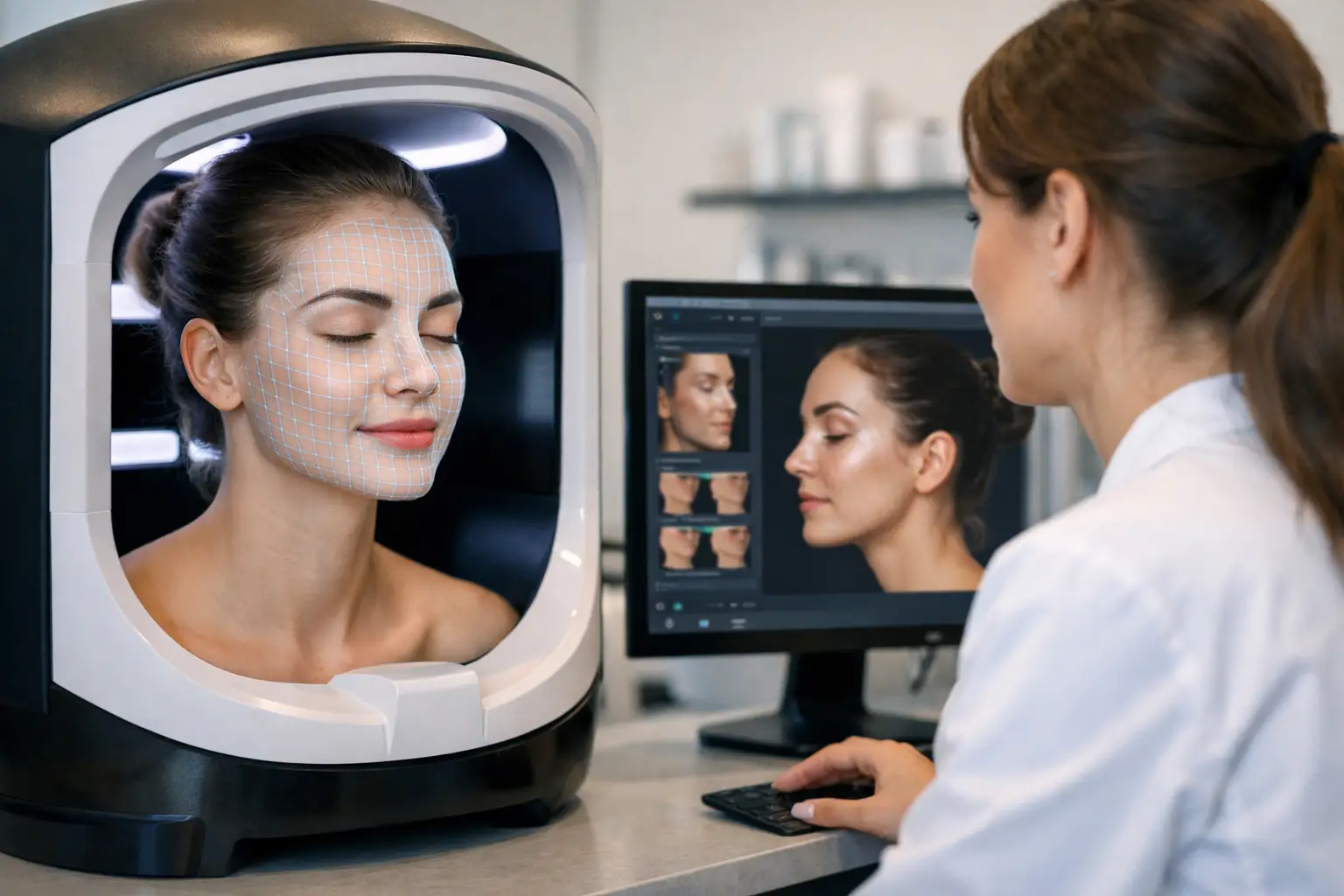
A patient says, "I just want to look fresher, not different." That single sentence is where many aesthetic consultations either gain momentum or stall out. The gap is rarely clinical skill. It is translation. Patients struggle to describe what they want, and clinics need a clearer way to turn subjective goals into precise, visible treatment plans. That is where facial scanning for aesthetic clinic workflows starts to matter.
This is not about adding flashy tech to the consult room. It is about creating a better decision environment. When a clinic can capture the face accurately, visualize structure in 3D, and compare baseline data over time, the conversation changes. Expectations become clearer. Planning becomes more measurable. And the clinic moves from opinion-led selling to data-informed guidance.
Why facial scanning is becoming core clinic infrastructure
Aesthetic medicine has always depended on visual judgment, but visual judgment alone does not scale well. It varies by provider, by lighting, by angles, and by what the patient remembers from their last visit. Standard photography helps, but it still compresses a three-dimensional face into a flat frame. That creates limits, especially when the treatment discussion involves contour, symmetry, volume, or progression over time.
Facial scanning for aesthetic clinic operators introduces a more structured layer of reality capture. Instead of relying only on photos and notes, the clinic can work from a spatial representation of the patient. That has implications across the full workflow - consultation, treatment planning, documentation, follow-up, and even patient retention.
For high-growth clinics, the commercial case is straightforward. Better visualization can shorten consult friction, improve confidence before treatment, and create stronger continuity across repeat visits. It also helps standardize how teams communicate internally. A lead injector, patient coordinator, and medical director can all reference the same digital facial data instead of interpreting still images differently.
This matters even more in a market where patient expectations are shaped by filters, social media, and highly polished before-and-after content. Clinics need tools that bring the conversation back to anatomy, realism, and measurable planning.
What facial scanning for aesthetic clinic workflows actually improves
The first improvement is consultation quality. A patient who cannot articulate concerns precisely can still react to a 3D view of their own face. Seeing contours from multiple angles often reveals priorities more clearly than a mirror does. The provider can point to specific areas, explain treatment logic with more authority, and reduce the ambiguity that often causes hesitation.
The second improvement is treatment planning. Facial aesthetics is full of small decisions with compounding effects. Volume placement, balancing asymmetry, jawline refinement, skin changes, and post-procedure comparison all benefit from better spatial reference. A scan does not replace expertise, but it gives expertise a stronger operating surface.
The third improvement is longitudinal tracking. Patients rarely remember exactly how they looked six months ago, especially after gradual changes. A structured scan history helps clinics demonstrate progression over time. That is useful for injectables, skin treatments, contouring programs, surgical consults, and maintenance plans. It gives the clinic a visual record that is easier to compare than trying to line up inconsistent photos.
The fourth improvement is trust. Patients are more likely to move forward when they feel seen accurately and guided clearly. That does not mean every clinic needs high-end hardware in every room. It means the technology should reduce uncertainty, not introduce complexity.
The real business value is not the scan. It is the workflow.
A lot of aesthetic technology gets bought for the demo and abandoned in the day-to-day. That usually happens when the tool is impressive in isolation but poorly matched to clinic operations. The strongest facial scanning systems are not just good at capture. They fit how modern clinics actually work.
That means speed matters. Staff should be able to capture usable data without turning the consultation into a technical event. Accessibility matters too. If scanning depends on expensive, fixed hardware and specialized setup, adoption often shrinks to a single room or a single provider. Data quality is critical, but so is operational flexibility.
This is where smartphone-based spatial capture becomes strategically interesting. The market is moving away from the assumption that advanced 3D capture must live inside bulky, dedicated systems. Clinics want mobility, lower friction, and easier deployment across locations. They also want technology that can plug into broader digital workflows rather than sit as a standalone device.
That shift is bigger than aesthetics. It reflects a broader move toward spatial AI becoming usable through mainstream hardware. For clinics, that opens the door to more scalable capture models without automatically sacrificing utility.
What to evaluate before adopting facial scanning for aesthetic clinic use
Not every clinic needs the same setup, and not every scanning solution fits the same stage of growth. A single-provider med spa has different needs than a multi-location aesthetic group. The right decision depends on procedure mix, patient volume, team structure, and how central visualization is to the sales process.
Start with capture consistency. If scans are difficult to reproduce in normal clinic conditions, the tool becomes hard to trust. Lighting variation, operator error, and patient movement all affect output. A system should be designed to minimize that friction.
Then look at output usability. A precise scan is only valuable if the clinic can use it in consultation and follow-up. Can providers review it quickly? Can teams compare sessions over time? Does it support visual communication that patients can understand without technical explanation?
Integration is the next filter. Clinics already juggle EMRs, imaging, patient communication software, and operational dashboards. Adding another disconnected platform creates drag. The more a scanning solution can function as part of a broader workflow, the stronger the return.
Finally, consider scalability. Many clinics first buy for one provider and later want to deploy across departments or locations. If adoption depends on a specialist, growth gets bottlenecked. The better model is infrastructure that starts simply and expands cleanly.
Where clinics can overestimate the technology
There is a temptation to treat 3D facial scanning as a shortcut to better outcomes. It is not. A scan does not make a weak consultation strong on its own, and it does not substitute for anatomy knowledge, aesthetic judgment, or ethical patient selection.
There are also practical limits. Some patients are motivated by subtle emotional concerns rather than visible structural issues. In those cases, more data does not always create more clarity. Sometimes a scan supports the conversation. Sometimes it risks making the interaction feel too technical if the patient mainly wants reassurance and expert interpretation.
Privacy and consent also need serious handling. Facial data is sensitive. Clinics adopting this technology should be clear about what is captured, how it is stored, who can access it, and how it supports patient care. Trust grows when the clinic treats digital face data with the same seriousness as any other medical information.
So yes, the opportunity is real. But the clinics that benefit most are the ones that treat scanning as part of a disciplined patient experience strategy, not as a gadget.
The next wave of patient experience is spatial
Aesthetic medicine is moving toward more visual, predictive, and data-supported care. Patients increasingly expect clinics to explain not just what a treatment is, but how it relates to their own face in a concrete way. Spatial capture helps meet that expectation.
For forward-looking operators, this is about more than nicer consults. It is about building a clinic system that can capture reality once and use it across planning, communication, tracking, and future digital applications. That creates compounding value over time.
Platforms built around smartphone 3D capture are accelerating that shift by making advanced scanning more deployable at scale. Companies like MagiScan are part of that broader movement, turning everyday devices into production-ready spatial tools and extending capture into a larger AI and AR ecosystem. That matters because the future clinic will not run on isolated hardware. It will run on connected spatial data.
The competitive edge will not come from having a scanner in the room. It will come from knowing how to use facial scanning to make every consultation sharper, every plan more defensible, and every patient interaction more concrete.
Aesthetic clinics that adopt this early are not just buying technology. They are building a more legible version of care - one patients can see, understand, and trust.