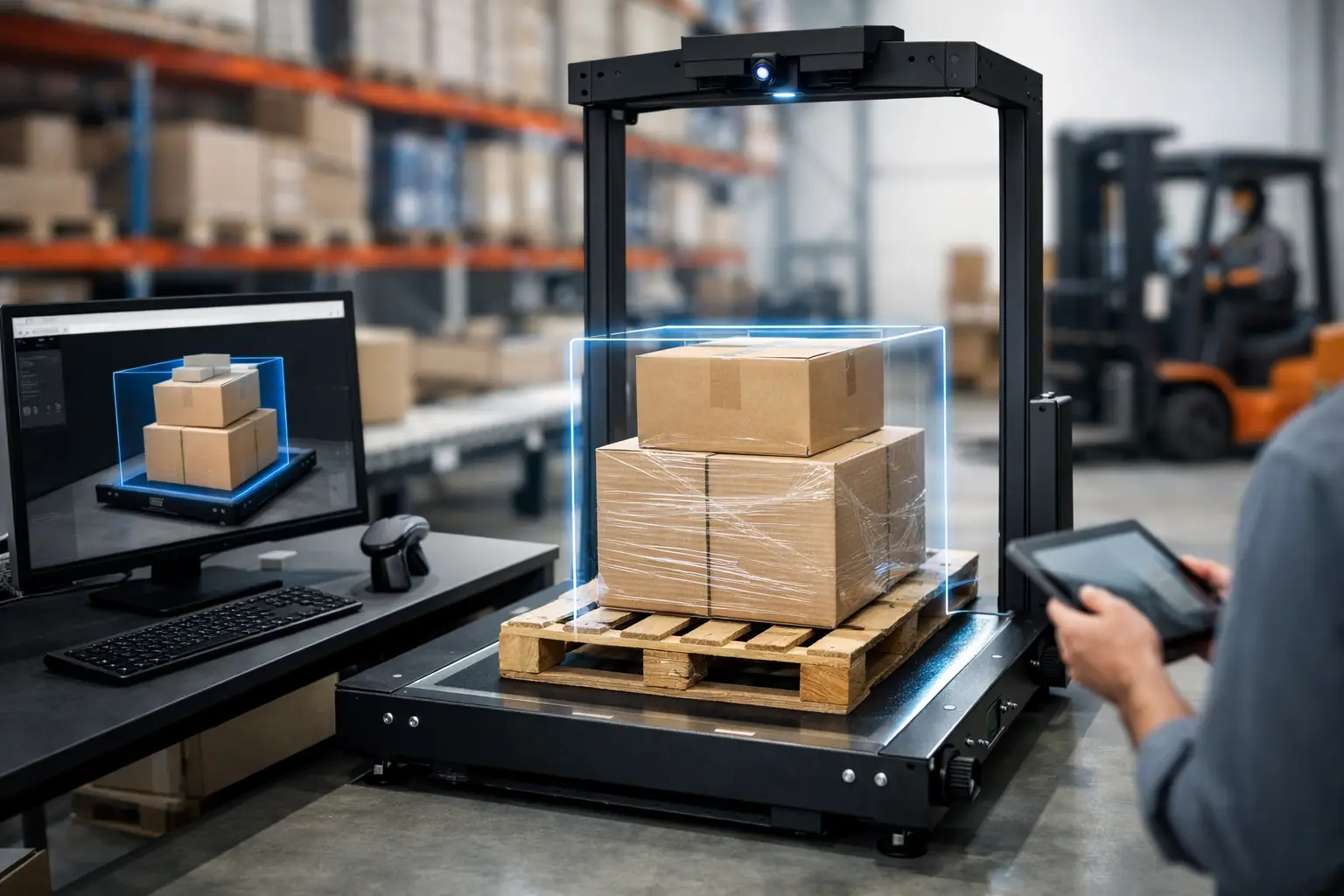
A pallet shows up at the dock labeled one way, stacked another way, and billed as something else entirely. That gap between what freight is supposed to be and what it actually is is where margin leaks, claims start, and throughput slows down. Freight dimensioning software exists to close that gap by turning physical cargo into reliable operational data the moment it enters the workflow.
For carriers, 3PLs, warehouses, and shippers, this is no longer a nice-to-have layer of automation. It is infrastructure. If dimensions are captured late, inconsistently, or with too much manual handling, every downstream system inherits bad inputs. Rating is off. Space planning is off. Audit trails are weak. Labor gets pulled into exception handling instead of volume movement.
What freight dimensioning software actually does
At its core, freight dimensioning software measures length, width, and height, then converts those measurements into usable records inside freight operations. The best systems do more than produce cubic volume. They attach dimensions to shipment IDs, images, timestamps, operator records, and billing workflows so measurement becomes part of a broader decision system.
That distinction matters. A measurement tool tells you how big something is. Freight dimensioning software tells your operation what to do with that fact. It can support freight class verification, DIM weight calculation, dock validation, warehouse slotting, carrier compliance, and invoice accuracy from a single capture event.
This is why dimensioning has moved out of the corner of the warehouse tech stack. It now sits closer to revenue assurance, network planning, and customer experience. When a shipment is dimensioned correctly at intake, teams spend less time arguing over discrepancies later.
Why manual measurement breaks at scale
Manual tape measurements work until they do not. They depend on operator consistency, clear access to freight, and enough time on the dock to stop and measure without slowing everything else down. In low-volume environments, that may be acceptable. In high-throughput facilities, it becomes expensive very quickly.
The first problem is variability. Different workers measure differently, especially with irregular freight, overhangs, soft packaging, or unstable loads. The second is timing. If a team has to choose between keeping freight moving and capturing exact dimensions, speed usually wins. The third is documentation. Even when workers capture dimensions correctly, disconnected records make disputes hard to resolve.
Software-based dimensioning changes the trade-off. Instead of asking labor to pause operations for measurement, it embeds measurement into normal freight flow. That does not eliminate exceptions, but it reduces the number of shipments that require manual intervention.
What good freight dimensioning software looks like
Not all platforms solve the same problem. Some are built for static dimensioning stations. Others focus on mobile capture, edge cases, or flexible deployment across distributed operations. The right choice depends on freight profile, facility design, and how much of the process you want to automate.
A strong platform starts with measurement accuracy, but accuracy alone is not enough. It also needs speed, consistent capture across operators and locations, and output that flows into the systems your business already runs. If dimension data lives in a silo, the operational value drops fast.
The most effective freight dimensioning software usually includes image-backed records, shipment association, support for irregular freight, and workflow integration with WMS, TMS, or billing systems. Mobile-first capture can be especially valuable where fixed hardware is too rigid, too costly, or too slow to deploy across multiple sites.
That last point is increasingly important. Logistics networks are not static. New facilities open. Cross-docks change layouts. Overflow locations appear during peak. A dimensioning strategy tied only to heavy fixed equipment can limit how quickly the business adapts.
Freight dimensioning software and revenue protection
One of the clearest business cases for dimensioning software is revenue protection. If shipment dimensions are understated, carriers lose billable revenue. If dimensions are overstated, shippers and customers question the invoice. Neither side benefits from uncertainty.
Reliable dimension capture creates a factual record. That record can validate freight class assumptions, support DIM-based billing, and reduce disputes around charge corrections. In practical terms, that means fewer reweigh conversations, fewer manual audits, and better confidence in invoice integrity.
There is a strategic layer here too. Once dimensions are captured consistently, operators can analyze packaging efficiency, identify recurring offenders, and spot network patterns that create avoidable cost. The software stops being just a measurement tool and starts acting like a source of operational intelligence.
Where deployment decisions get real
This is where many buying decisions go wrong. Teams get pulled toward spec sheets without defining the actual operating environment. A solution that performs well in a controlled demo may struggle with mixed freight, dock congestion, poor lighting, or uneven operator behavior.
A better evaluation starts with your freight reality. Are you measuring boxed parcels, palletized LTL, bulky returns, odd-shaped industrial components, or all of the above? Do you need fixed stations for predictable flow, or mobile capture for exceptions and distributed sites? Are dimensions being captured for billing, internal planning, customer transparency, or all three?
There is no universal answer. Fixed systems can deliver excellent throughput in structured environments. Mobile and smartphone-based approaches can reduce deployment friction and expand coverage where permanent infrastructure is not practical. For many operations, the smartest path is hybrid. Use fixed dimensioning where volume is concentrated and flexible software-based capture where operations are variable.
Why smartphone-based capture is changing the market
The old model treated freight dimensioning as specialized hardware territory. That made sense when camera quality, on-device processing, and spatial computing capabilities were limited. That constraint is disappearing.
Smartphone-based freight dimensioning software changes the economics of adoption. It lowers the barrier to rollout, reduces dependence on dedicated stations, and gives teams a way to capture dimensions where freight actually appears, not just where hardware happens to be installed. For distributed logistics operations, that flexibility is significant.
It also changes the speed of implementation. Instead of waiting for facility modifications and hardware procurement cycles, teams can test workflows faster, train staff faster, and standardize measurement across more locations. The technology is no longer confined to large capex projects. It can be deployed as operational software.
This is where spatial AI becomes commercially meaningful. A modern platform can turn widely available devices into measurement infrastructure, which expands who can use dimensioning software and where it can create value. That shift aligns with a larger reality across logistics and industry: intelligence is moving to software layers that can scale faster than physical equipment alone.
What to ask before you buy
If you are evaluating freight dimensioning software, the first question is not feature count. It is operational fit. Ask how the system performs with the freight you actually handle, how it manages exceptions, and how quickly data becomes usable downstream.
Then ask about evidence. Can the platform provide image-backed records? Can it tie dimensions to shipment identifiers without extra manual steps? Can it support auditability when customers or carriers challenge a charge? These are not edge concerns. They are core to real-world adoption.
Integration deserves equal attention. Dimension data should move into billing, warehouse, and transportation workflows without forcing teams to rekey information. If the software creates another disconnected screen for operators, adoption will stall.
Finally, look at scale in practical terms. Scale does not only mean enterprise volume. It means how easily the solution expands to new sites, new workflows, and new freight types without a full redesign. That is where platform thinking matters most.
For companies building around spatial computing, this is the larger opportunity. Measurement is not the endpoint. It is the entry point into a richer operational layer where physical objects become structured digital assets. MagiScan is part of that shift, extending 3D capture beyond a single app into vertical systems that make spatial data usable in commerce, healthcare, and cargo operations.
The next standard for freight dimensioning software
The market is moving toward faster capture, lower deployment friction, and better operational context around every measurement. That favors software-led systems that can combine dimensional accuracy with images, identifiers, mobility, and workflow integration.
The winners in this category will not be the tools that simply measure boxes. They will be the platforms that make freight measurable anywhere, make the data trustworthy everywhere, and make the result actionable across the business. That is a bigger standard than dimensioning alone.
If your operation still treats dimensions as a manual checkpoint, there is a good chance you are underestimating how much value is trapped between the dock and the database. The companies that move first will not just measure freight more efficiently. They will run a more informed network because of it.