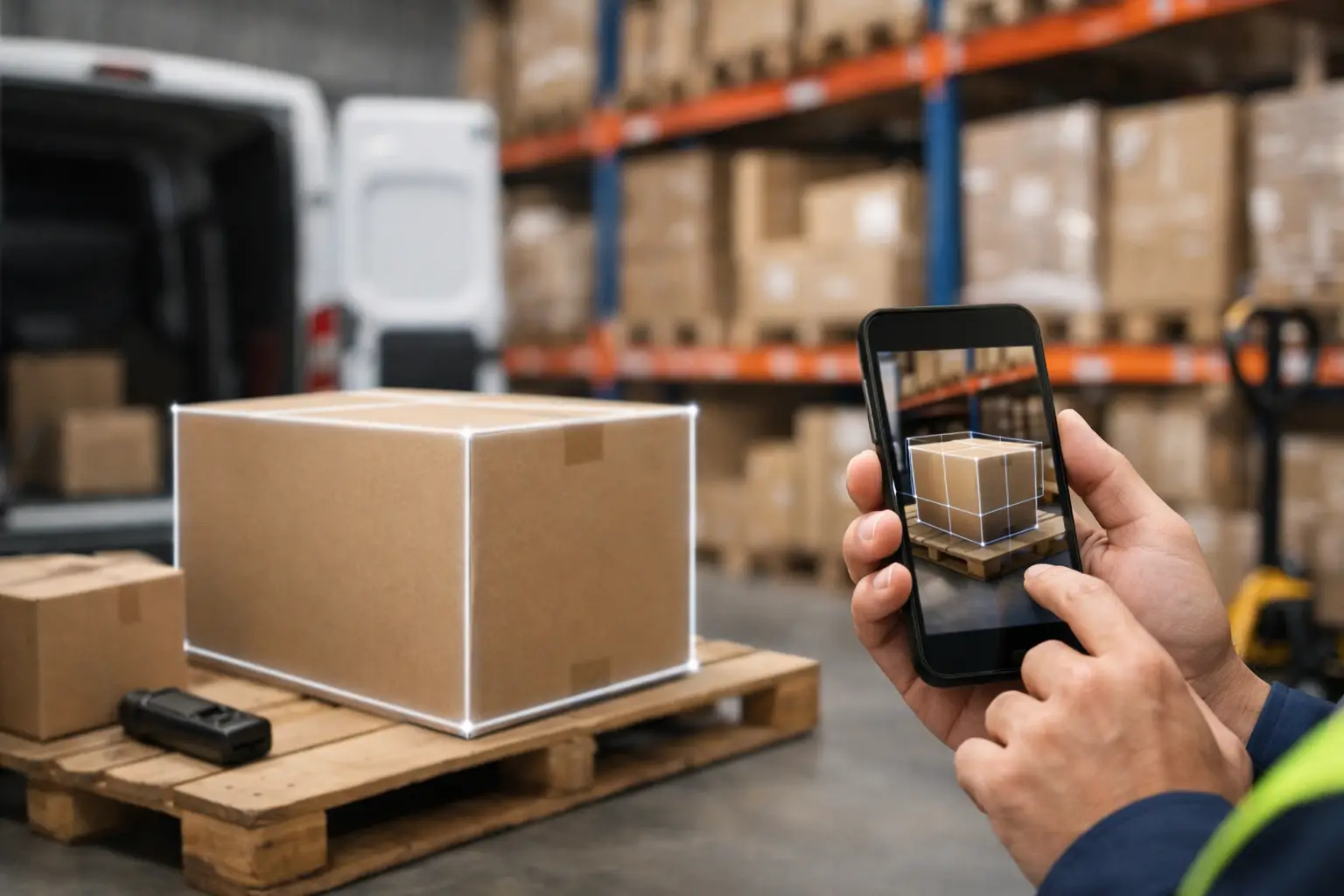
Every lost inch in freight quoting turns into a real cost. Underestimate cargo volume and margins disappear. Overestimate it and pricing gets uncompetitive fast. That is why a cargo volume measurement app is no longer a nice-to-have for logistics teams, warehouse operators, and freight platforms trying to scale without adding friction.
The old method still shows up everywhere - tape measures, handwritten dimensions, rough estimates from operators under time pressure, and data re-entry into downstream systems. It works just enough to survive, but not enough to win. Freight is already a margin-sensitive business. Measurement should not be the weakest link.
Why a cargo volume measurement app matters now
Freight operations are moving toward mobile-first infrastructure. The teams handling cargo do not sit behind desktops all day. They work on warehouse floors, at loading docks, in yards, and in the field. Any measurement tool that depends on extra hardware, training overhead, or manual transcription introduces drag.
A strong cargo volume measurement app changes that by turning a smartphone into a practical spatial data tool. Instead of relying on rough estimation, teams can capture dimensions where the cargo actually sits, generate volume data quickly, and feed that information into quoting, billing, planning, or compliance workflows.
That shift matters because volume is not just a number. It affects pricing logic, load planning, vehicle utilization, dimensional weight calculations, and claims risk. When measurement becomes faster and more consistent, decision-making improves across the operation.
What the best cargo volume measurement app actually solves
At a surface level, the use case seems simple: measure cargo and calculate cubic volume. In practice, the problem is broader.
The real issue is fragmentation. One person measures. Another records. A third enters the information into a freight system. Somewhere along the way, units get mixed up, dimensions get rounded, or irregular loads get simplified into clean rectangles that do not reflect reality. The cost of those small errors compounds.
A serious cargo volume measurement app should reduce that fragmentation. It should let teams capture cargo dimensions from a mobile device, calculate volume with minimal guesswork, and create data that can be trusted by operations, finance, and customer-facing teams alike.
Speed matters, but accuracy is the real multiplier. If a tool is fast and unreliable, it just helps teams make bad decisions more efficiently. On the other hand, if it is highly accurate but too slow for real warehouse conditions, adoption stalls. The best products sit in the middle - accurate enough for commercial use and fast enough for real-world throughput.
What to look for in a cargo volume measurement app
The first requirement is obvious: it has to work in the field. That means mobile capture should be intuitive, not built for a lab environment. Operators should be able to measure pallets, cartons, and irregular freight without needing specialized training or a lengthy setup process.
The second requirement is consistency. A cargo volume measurement app should produce repeatable results across users and environments. Lighting, cargo shape, and floor conditions vary. If every scan depends on perfect conditions, the tool becomes a demo feature instead of operational infrastructure.
The third requirement is output quality. The app should generate usable dimensions and volume data, not just a visual scan. In logistics, capture is only step one. The output needs to support quoting, documentation, load planning, auditing, or integration into broader freight workflows.
The fourth requirement is scalability. A single measurement on a phone is helpful. Thousands of measurements across teams, sites, and shipment types is where the real business case appears. That is the difference between an app utility and a category-defining platform.
Smartphone capture changes the cost structure
This is where the market has shifted. Traditional dimensioning systems can be effective, but they often come with hardware costs, installation constraints, and limited flexibility. That model makes sense for certain high-volume fixed environments. It makes less sense when cargo is measured across distributed operations, temporary locations, or mixed workflows.
A smartphone-based cargo volume measurement app changes the economics. The device is already in the operator's hand. Deployment can move faster. Expansion across teams becomes easier. New workflows can be tested without a major capital decision.
That does not mean phones replace every dedicated system. In some operations, fixed hardware will still outperform mobile tools for nonstop throughput or highly standardized lanes. But many businesses do not need measurement infrastructure everywhere. They need flexible measurement where work actually happens.
That is the practical opportunity. Mobile spatial capture lowers the barrier to digitizing freight measurement at scale.
The trade-offs are real
Not every cargo environment behaves the same way. Dense warehouse traffic, poor lighting, reflective packaging, shrink wrap, and oddly shaped freight can all affect capture quality. Anyone evaluating a cargo volume measurement app should be honest about those edge cases.
The right question is not whether the app works perfectly in every scenario. The right question is whether it materially improves measurement quality, speed, and consistency for the workflows that matter most.
For some teams, the app will be ideal for exception handling, spot checks, field pickups, and distributed measurement. For others, it may become the default layer across the operation. It depends on cargo mix, throughput, tolerance for variance, and how measurement data is used downstream.
This is why platform design matters more than feature count. The strongest products are not trying to be clever. They are built to survive operational reality.
Cargo volume measurement app adoption is really a workflow decision
Buying a measurement tool is easy. Embedding it into a freight operation is harder.
If dimensions captured in the app never reach quoting systems, warehouse records, or billing processes, the value stays trapped at the device level. If the app produces data but teams do not trust it, they go back to manual methods. If the process adds extra steps, adoption fades.
That is why the category is moving beyond standalone measurement. The more valuable model is an ecosystem approach where capture, processing, and application work together. A measurement event should feed a larger spatial data workflow, not live as an isolated task.
This is where companies building beyond a single app have an advantage. A platform mindset creates more leverage than a narrow utility because it treats spatial data as reusable infrastructure. Cargo measurement becomes one vertical application inside a broader 3D and AI stack rather than a one-off feature.
MagiScan operates from that position. The company has already proven consumer-scale adoption with more than 4 million installs and over 16 million 3D models created, then extended that core scanning infrastructure into commercial verticals including freight. That matters because logistics teams are not betting on a gimmick. They are adopting a spatial computing layer designed to turn real-world objects into usable digital data.
Where the business impact shows up
The clearest gains from a cargo volume measurement app usually appear in quoting speed, billing confidence, and labor efficiency. Teams spend less time measuring manually, less time rechecking disputed dimensions, and less time reconciling inconsistent records.
There is also a utilization story. Better dimensional data can improve how freight is assigned, stacked, or consolidated. Even small gains in cubic accuracy can matter when repeated across hundreds or thousands of shipments.
Customer experience improves too. When dimensions are captured quickly and documented clearly, disputes become easier to manage. Internal teams make decisions faster, and external communication becomes more credible. In freight, trust is built through operational precision.
The strategic upside is larger still. Once cargo measurement becomes digital and mobile, it becomes analyzable. Patterns emerge. Exceptions become visible. Volume data can support forecasting, pricing refinement, and network decisions. What starts as a measurement upgrade can become a planning advantage.
The category is heading toward spatial intelligence
The most ambitious view of a cargo volume measurement app is not that it replaces the tape measure. It is that it turns cargo into machine-readable inventory.
That shift opens the door to richer automation across logistics. Volume data can inform AI-assisted quoting, warehouse orchestration, exception detection, and visual documentation. As mobile 3D capture improves, the role of the app expands from measurement tool to spatial interface for freight operations.
That is the real trajectory of the market. Measurement is the entry point. Spatial intelligence is the destination.
The companies that move early will not just save time on the dock. They will build cleaner operational data, stronger pricing discipline, and a more adaptable freight stack. In a market where efficiency gets copied quickly, better spatial data is one of the few advantages that compounds.