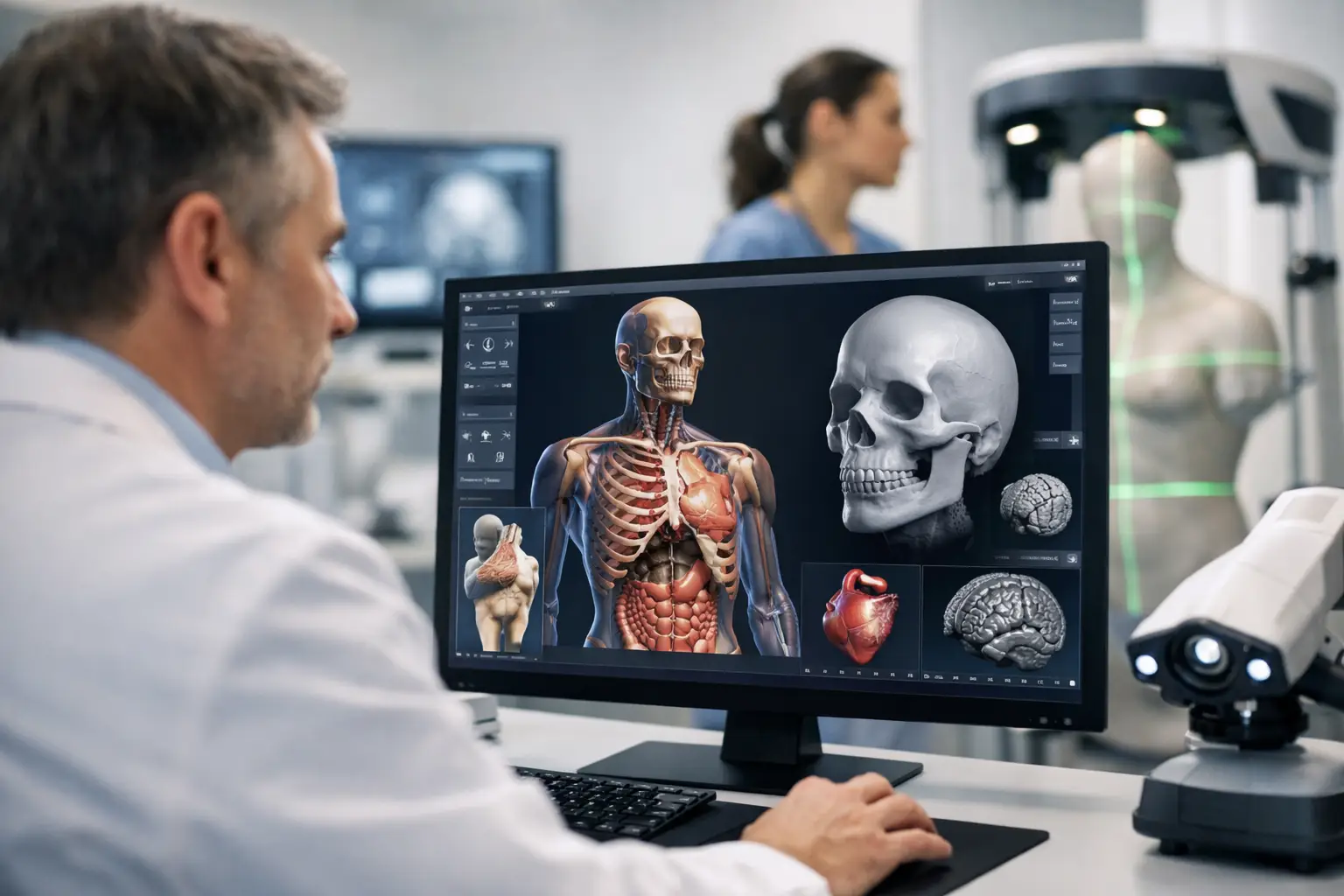
A scan that looks good on screen is not the same as a scan that holds up in a medical workflow. That gap is where most buying decisions get expensive. Medical 3D scanning software is not judged by novelty. It is judged by whether it can turn anatomy, surfaces, and measurements into usable clinical data without slowing the people who rely on it.
That changes the conversation. The real question is not whether software can create a 3D model. Plenty of tools can. The question is whether it can do that fast enough, accurately enough, and consistently enough to support treatment planning, device creation, documentation, and patient communication at scale.
What makes medical 3D scanning software different
Medical use cases punish weak software quickly. In creative or retail environments, a slightly imperfect mesh may still be useful. In medicine, small deviations can affect fit, comfort, and clinical decisions. A facial scan used for aesthetic simulation, a limb scan for orthotics, or a torso scan for preoperative planning each carries different tolerances, but none of them leave much room for guesswork.
That is why medical 3D scanning software has to do more than reconstruct geometry. It needs to preserve clinically relevant shape, manage difficult surfaces such as skin and soft tissue, and produce outputs that fit into downstream workflows. If the software captures detail but creates cleanup headaches, the efficiency gain disappears. If it is accurate but too slow for a busy practice, adoption stalls.
This is also where mobility starts to matter. Traditional hardware-heavy setups can still make sense for high-control environments, but healthcare is moving toward faster, more flexible capture. Clinics want tools that can be used chairside, at bedside, or across distributed locations without building a dedicated scanning room around them.
The core capabilities that actually matter
Accuracy gets the attention, and rightly so, but accuracy without repeatability is not enough. A platform has to produce dependable results across operators, lighting conditions, patient movement, and varied anatomy. That is what makes software operational, not just technically impressive.
Processing intelligence matters just as much. Good software identifies what belongs in the scan, reduces noise, fills gaps carefully, and preserves edges that affect fit and measurement. Bad software smooths away the details that matter or forces technicians to spend too much time repairing the model manually.
Speed is another hard requirement. In medicine, every extra minute of friction compounds. Slow capture frustrates patients. Slow processing creates bottlenecks. Slow export delays treatment. The best systems compress the path from scan to action. That may mean generating a model for prosthetic design, documenting body shape changes over time, or visualizing treatment plans for patient approval.
Then there is interoperability. Medical teams rarely work in a single software environment. Scans may need to move into CAD tools, surgical planning platforms, orthotics workflows, AR visualization layers, or record systems. If the scanning software traps data in a closed loop, it limits enterprise value. Strong platforms treat 3D capture as infrastructure, not a standalone novelty.
Where medical 3D scanning software creates the most value
The commercial case becomes much clearer when you look at specific verticals.
In orthotics and prosthetics, 3D scanning replaces messy, slow, and often inconsistent casting methods with digital capture that can be repeated and stored. That improves turnaround time and makes remote or distributed care models more realistic. But it only works when the software captures body geometry reliably enough to support fabrication.
In aesthetic medicine and plastic surgery, the value is not only in documentation. It is also in simulation, communication, and patient trust. A 3D scan can help practitioners explain treatment plans and show before-and-after changes with more clarity than flat photography. Yet this use case depends heavily on realistic surface quality and a workflow that feels fast in the exam room.
In rehabilitation and long-term monitoring, the software has to support comparison over time. That means consistent scan alignment, repeatable measurement logic, and a clean way to visualize progression. A single scan can be informative. A series of scans becomes operational intelligence.
In wound care, dermatology, and body-surface analysis, it depends on whether the system can balance practicality with sufficient detail. Not every use case demands the same precision, and not every practice can justify specialized hardware. That is where smartphone-led capture has strategic weight. It lowers the barrier to adoption while expanding where and how scanning can happen.
Why mobile-first platforms are changing the category
The old assumption was simple: serious medical scanning required expensive dedicated equipment. That assumption is getting weaker.
Smartphone-based capture, when paired with strong AI reconstruction and workflow design, changes the economics of deployment. It brings scanning into settings where capital budgets, room constraints, or staffing models would otherwise block adoption. It also makes scaling easier across multi-site operations, field teams, or partner networks.
The trade-off is obvious. Mobile systems must work harder in software to compensate for less controlled capture conditions. That means the quality of the reconstruction engine, the intelligence of object and surface detection, and the reliability of post-processing matter even more. A weak mobile stack produces consumer-grade results. A strong one turns commodity hardware into a serious production tool.
That distinction is where category leaders separate themselves. The future of medical scanning is not just better sensors. It is software that turns available sensors into dependable spatial data pipelines.
How to evaluate medical 3D scanning software realistically
Most teams should start by mapping the software to a workflow, not to a feature checklist. A platform may look impressive in a demo and still fail in deployment because it does not match how patients are seen, how technicians work, or how files move downstream.
Ask a more practical set of questions. How long does capture take for the actual anatomy you scan most often? How much manual cleanup is required before the file becomes useful? Can non-specialist staff operate it consistently? Does it support the export formats and integrations your production process already depends on? Can it scale from one practitioner to multiple sites without a support burden that erases the savings?
It is also worth testing edge conditions instead of ideal conditions. Scan different skin tones. Scan in less-than-perfect lighting. Scan patients who cannot hold still for long. Scan anatomies that are difficult because of curvature, symmetry, or soft tissue variation. Medical environments are messy. Evaluation should be honest about that.
Security and governance matter too, even when the product conversation is focused on scanning quality. If 3D patient data becomes part of treatment planning or documentation, the software has to fit the organization’s standards for privacy, storage, access, and compliance. Great geometry does not excuse operational risk.
The platform shift behind the best medical 3D scanning software
The strongest products in this category are no longer just capture tools. They are platforms that connect scanning, AI processing, visualization, and vertical workflows into one system. That matters because the value of a scan is realized after capture, not during it.
A clinic does not buy scanning software to admire point clouds. It buys software to reduce friction in care delivery, improve fit and communication, generate usable digital assets, and build a repeatable process around spatial data. That is why isolated tools struggle over time. They solve one step, then create problems in the next.
This is where ecosystem players have an advantage. A company like MagiScan is not approaching 3D capture as a single-function utility. It is building spatial infrastructure that extends from mobile scanning to AI-generated 3D workflows and applied vertical solutions, including medical use cases. That kind of architecture is better aligned with where healthcare technology is going - away from disconnected tools and toward integrated spatial systems.
The market will keep rewarding software that makes 3D data easier to capture, easier to trust, and easier to apply. Not every practice needs the same level of precision, and not every workflow should be rebuilt around scanning. But when the software fits the job, it does more than digitize anatomy. It compresses the distance between the physical patient and the digital decision. That is where this category stops being impressive and starts being indispensable.
If you are evaluating the space, look past the demo mesh and focus on what happens next. The right platform will make that answer obvious.